

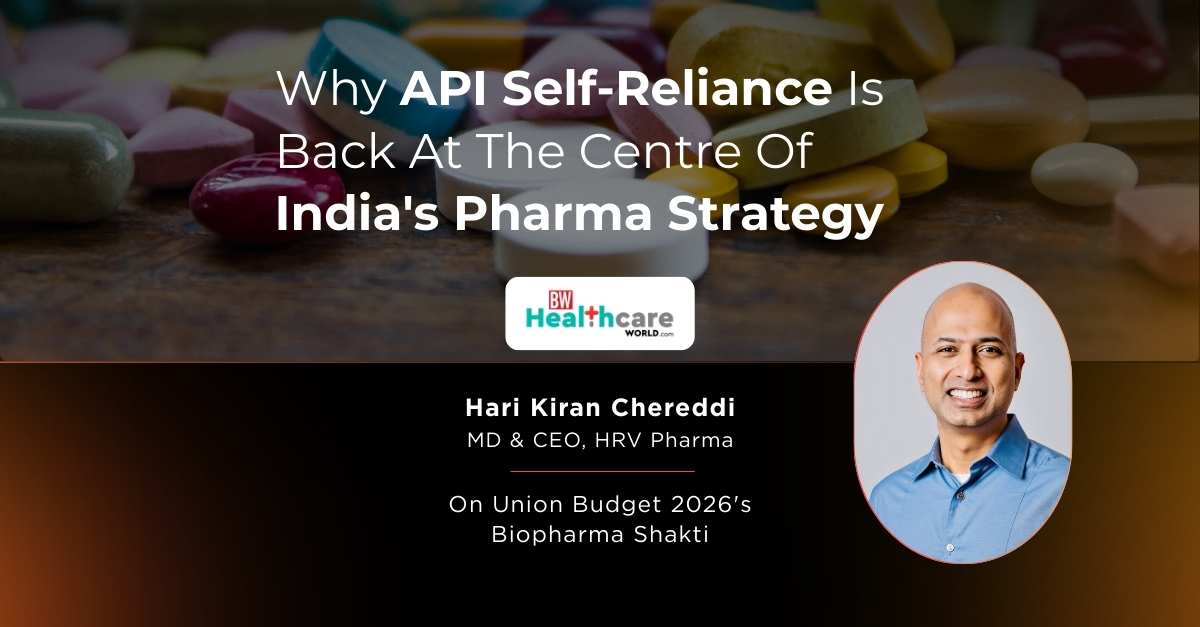
In a recent feature published by BW Healthcare World, our MD & CEO, Hari Kiran Chereddi, shared his perspective on why API self-reliance has re-emerged at the centre of India’s pharmaceutical strategy.
While the Union Budget 2026 announcement of Biopharma SHAKTI highlighted biologics and biosimilars, Hari Kiran Chereddi pointed to the deeper structural shift underway: India is reinforcing the foundation of its pharmaceutical ecosystem through renewed focus on upstream API resilience.
A ₹10,000 Crore Structural Commitment
Biopharma SHAKTI carries an allocation of ₹10,000 crore over five years. Beyond financial commitment, the initiative signals long-term capability building through:
- Expansion of clinical research capacity with over 1,000 accredited trial sites
- Establishment of three new National Institutes of Pharmaceutical Education and Research (NIPER)
- Upgradation of seven existing NIPER institutions
- Strengthening of CDSCO through a dedicated scientific review team
According to Chereddi, this reflects structural recalibration rather than short-term stimulus.
Why API Self-Reliance Matters Now
In his interaction with BW Healthcare World, he emphasized that a strong biologics and biosimilars sector cannot be built on heavy reliance on imported intermediates. From key starting materials to specialty reagents, upstream resilience determines cost stability, pricing predictability, and long-term competitiveness.
Recent geopolitical tensions and supply-chain disruptions have demonstrated how quickly concentrated sourcing can impact availability. Overdependence on limited geographies increases systemic vulnerability.
“API self-reliance is not about cutting the world out. It’s about building reliable, audit-ready supply chains that protect patients and safeguard India’s global reputation.”
— Hari Kiran Chereddi, MD & CEO, HRV Pharma
Execution Will Define Impact
Chereddi outlined key priorities to ensure Biopharma SHAKTI delivers lasting results:
- De-risking the API basket: Identifying single-source and import-heavy APIs while building supplier redundancy.
- Quality-first incentives: Rewarding compliance, data integrity, and environmental safeguards — not just production volume.
- Regulatory strengthening: Improving review efficiency without compromising scientific rigor.
- Investor confidence: Creating policy clarity and predictable approvals to attract long-term capital.
A Strategic - Not Isolationist - Shift
He underscored that API self-reliance should be viewed as strategic preparedness, not protectionism. The goal is not to disengage from global markets, but to strengthen India’s position as a trusted pharmaceutical partner.
If implemented with discipline, Biopharma SHAKTI could help move India from being primarily the “pharmacy of the world” toward becoming a science-led, structurally resilient provider of next-generation therapies.
As highlighted in BW Healthcare World, the renewed focus on API self-reliance marks a pivotal inflection point in India’s pharmaceutical evolution.
Article Link: BioPharma SHAKTI signals a strategic return to API self-reliance
Frequently Asked Questions
Q. What is Biopharma SHAKTI?
Biopharma SHAKTI is a ₹10,000 crore initiative announced in the Union Budget 2026 to strengthen India’s biopharmaceutical ecosystem through expanded research capacity, upgraded institutions, and enhanced regulatory infrastructure.
Q. Why is API self-reliance important for India’s pharmaceutical sector?
API self-reliance reduces dependence on imported intermediates, strengthens supply chain resilience, stabilizes pricing, and enhances India’s long-term global competitiveness in pharmaceuticals.
Q. Is API self-reliance a protectionist strategy?
No. As explained by HRV Pharma CEO Hari Kiran Chereddi in BW Healthcare World, API self-reliance is about strategic preparedness and building reliable, audit-ready supply chains rather than isolating India from global markets.
Q. How does Biopharma SHAKTI support long-term pharmaceutical growth?
The initiative supports clinical research expansion, NIPER capacity building, CDSCO scientific strengthening, and infrastructure upgrades to enable sustainable, innovation-led pharmaceutical growth.
Q. What could be the global impact of this policy shift?
If executed effectively, the renewed focus on API resilience could position India as a more reliable and structurally robust global supplier of next-generation therapies.